

Weight-Neutral • Anti-Diet Therapy · Oregon and Washington
Your body is not a
problem to be solved,
or evidence of failure.
Weight-inclusive, anti-diet therapy for body liberation and disordered eating with a Certified Body Trust® Specialist. Your body was never the problem, diet culture is, and it doesn't operate in a vacuum. We work to reclaim trust in your body, unlearn the rules you were handed, and make peace with the body you actually live in — no fixing required. Weight-neutral, shame-free, and clear-eyed about how body oppression intersects with every other system. Telehealth across Oregon and Washington.
______________________
A DIFFERENT DEAL
You were handed a deal nobody asked you to sign

You have probably spent a startling amount of your life at war with your own body — tracking it, shrinking it, apologizing for it. This is a very different space.
_______________________________________________

Body Trust®
Developed by Hilary Kinavey and Dana Sturtevant. The premise is radical: your body is a site of wisdom, not a liability.
_______________________________________________

Body Liberation
Struggling to trust your body isn’t a personal failing. It’s what living inside diet culture, fatphobia, and ableism reliably produces.
_______________________________________________

Certified, not gestured at
Body Trust® work at Soma Roots Therapy is led by Del Knight, a Certified Body Trust® Specialist — trained and practiced, not admired from a distance.
_______________________________________________

Certified Body Trust® Specialist
Weight-inclusive and anti-diet
Portland to Seattle and beyond
______________________
WHAT THIS CAN LOOK LIKE
Body distress, in costume
It rarely announces itself. It wears the costume of “health,” “discipline,” or “just being responsible.” A few of its disguises:

The mental calorie spreadsheet
A running background tally of food, movement, and bodily “debt” that never quite closes out.
Mirror roulette
The same body is “fine” on Tuesday and unbearable on Wednesday, and your mood pays the difference.
Clothes as a moral system
A closet sorted by the size you’re “working back to,” each item quietly assigned a verdict about you.
Hunger & rest, outsourced to rules
You’ve overridden your body so long you can’t always tell when you’re hungry, full, or tired.
“I’ll live once I’m smaller”
Beaches, dating, photos, dance class — deferred to a future body that keeps not arriving.
The doctor’s office dread
Bracing for the weight conversation every visit, sometimes skipping care to avoid it. That’s rational, not vain.______________________
HOW WE WORK HERE
We don’t prescribe a body
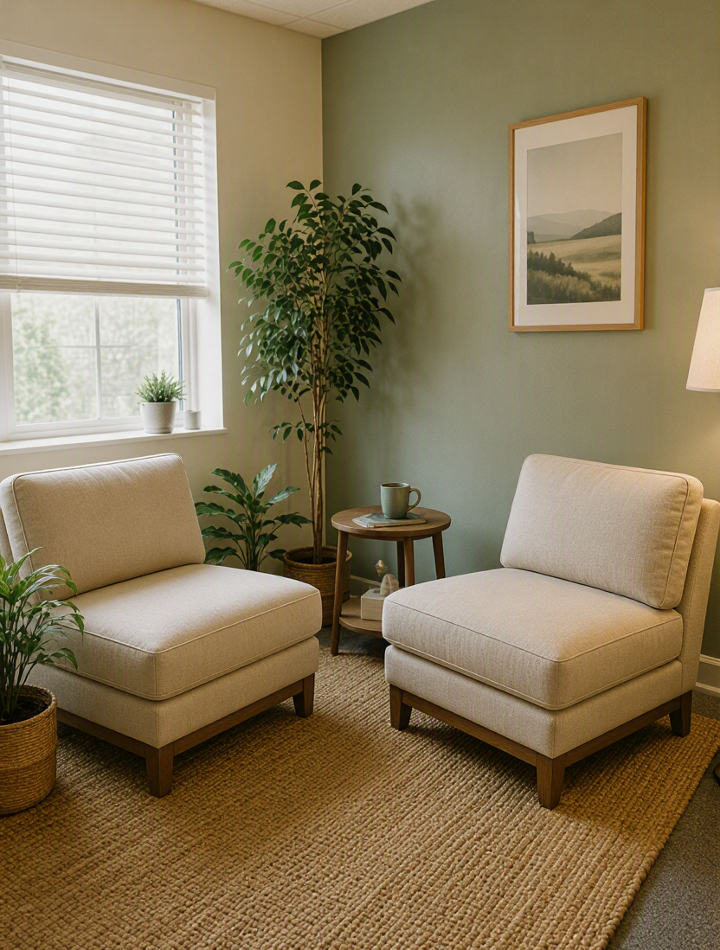
There is no goal weight on a sticky note in this office. The work isn’t about changing your size. It’s about ending the war.
_______________________________________________
No goal weight, no meal plan
Sometimes what surfaces is grief. Sometimes rage. Sometimes the decision that you don’t owe anyone a different body.
_______________________________________________
Decolonial and anti-oppression, all the way down
“Wellness” has a long history of ranking bodies by size, race, ability, and class, and calling it science. We name that.
_______________________________________________
Affirming, full stop
Your body, neurotype, disability, fatness, and gender are welcome without an edit pass. We celebrate the unglamorous wins.
_______________________________________________
Scope: body image and disordered eating. Acute eating disorders may be referred to specialized treatment when needed →
______________________
COMMON QUESTIONS
No wrong questions here
Including the ones that are hard to say out loud.
-
No. I won't refuse you, and I won't shame you for the wish. You didn't invent it; you were handed it, relentlessly, by a culture that made body size feel like a moral report card. Wanting to lose weight in a world like this is one of the most understandable things in the world.
Here's the honest part, so you can decide if we're a fit: this isn't weight-loss work, and I won't prescribe diets, plans, or goal weights because the evidence is clear that intentional weight-loss pursuits tend to backfire, and often leave people more at war with their bodies than when they started. What I can do is stay curious with you about what the wish is really carrying—safety, belonging, control, the hope of finally being treated well—and work toward those directly, in a body you don't have to earn your way into first. Plenty of people arrive wanting to shrink and stay because something better than shrinking turned out to be on offer. You're welcome exactly as you are.
-
Related cousins, not the same thing. Intuitive eating is a genuinely useful framework, and it lives mostly at the level of food and hunger cues. Body Trust® goes wider and deeper.
Body Trust (developed by the Center for Body Trust) is a weight-inclusive, trauma-informed roadmap for coming home to your body after years of being told it's a problem—reclaiming trust, unpacking the shame, and doing it with a clear eye on the systems that profit from your self-doubt: diet culture, healthism, capitalism, and the rest. So yes, food is part of it, but so are grief, embodiment, nervous-system safety, and the politics of whose bodies get called "good." It's less "learn to eat when you're hungry" and more "learn to live in your body as a whole person in an unjust world." Extra steps, sure, but they're the ones that actually hold.
-
Absolutely not. And if "love your body!" makes you want to hurl your phone across the room, we're going to get along fine.
Body positivity's demand that you adore your reflection can become one more thing to fail at. Body Trust® doesn't ask that. You can start from neutrality, ambivalence, exhaustion, grief, or outright dislike. The goal isn't forced love, it's trust and peace: being able to inhabit your body without it being a daily battlefield. Some days that looks like respect, some days like a truce, some days just "we're both still here." All of it is a valid place to begin. You don't have to feel a certain way about your body to deserve care in it.
-
Both, honestly. This work supports people healing from disordered eating and diagnosed eating disorders—restriction, bingeing, the exhausting mental arithmetic around food—as well as folks who've never had a "diagnosis" but have spent decades quietly at odds with their bodies, chasing the next plan, or bracing at the mirror.
One clear boundary, because it matters: eating disorders can be medically serious, and the most acute stages sometimes need a coordinated team—medical, nutritional, and sometimes a higher level of care—beyond what individual therapy alone can safely hold. If that's where you are, I'll be honest with you about it and help you get the right support, alongside or before this work. Wherever you land on that spectrum, we'll start by figuring out what you actually need. If you're in acute crisis, please reach out to a crisis line or the National Alliance for Eating Disorders helpline, and we can talk about next steps together.
-
I'm based in Camas, Washington, and all of this work happens through telehealth across both Oregon and Washington. So wherever you are in those two states, you can do body-liberation work from your own space.
For this work in particular, telehealth is often a gift: no waiting-room scales, no fluorescent-lit walk of dread, no being weighed or measured on the way in the door. Just you, in an environment you control, doing the slow work of coming home to your body. If you're an Oregon or Washington resident, you're eligible — and there's a free 20-minute consultation to feel out fit before anything begins.
Still have questions? Click the link below to book a free 20-minute consultation
______________________
ACCEPTING NEW CLIENTS
Curious but wary?
That’s a reasonable place to start. You don’t have to be sold on any of this, or ready to give anything up, to have one free conversation about it.
Confidential telehealth throughout Oregon and Washington —
Portland, Salem, Eugene, Bend, Seattle, Tacoma, Spokane, Vancouver, and everywhere between.
Body stuff rarely travels alone. See neurodivergent-affirming and gender-affirming therapy →