
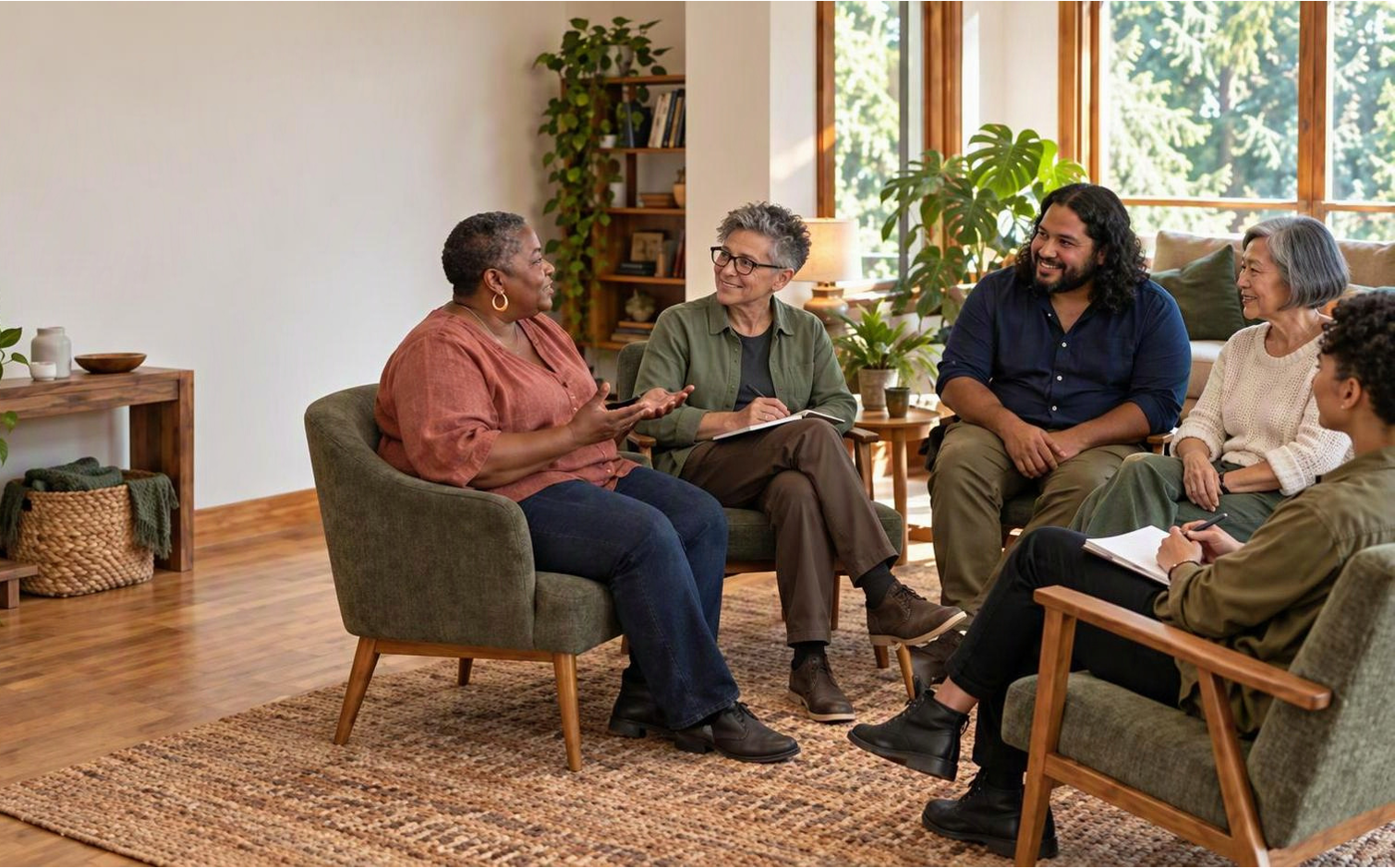
30-hour clinical supervision training for Oregon clinicians
Clinical Supervision
Without the Power Trip
Supervise with clarity, practical tools, and care.
First Cohort: January 8th - February 12th, 2027
What this training prepares you to do
Build a supervision framework
Connect supervision theory to everyday practice.Handle feedback and accountability
Give clear feedback and respond to concerns.Supervise with attention to power and access
Build an affirming, accessible supervision practice.Oregon Supervisor
Candidate Preparation
Designed to meet OBLPCT’s 30-clock-hour post-master’s supervision training requirement for eligible Supervisor Candidates.
Candidates also need an active Oregon LPC or LMFT license and a passing law and rules exam. Other requirements apply.
Source: Oregon Become a Supervisor page______________________
MY APPROACH TO SUPERVISION

Meeting you where you are
I don't believe supervision should feel like an audit of your competence, so let's skip that part.
My approach is developmental, relational, and unapologetically process-oriented, shaped by my own supervisors during doctoral training (the good ones, and the cautionary tales. Both taught me plenty). I aim to build a space where vulnerability, curiosity, and the occasional professional identity crisis are all welcome, because that's usually where the real growth lives.
____________________________________________

A space that makes room for not knowing
Vulnerability, curiosity, and the occasional professional identity crisis are all welcome, because that's usually where the real growth lives.
____________________________________________

IFS-informed, Gestalt, Somatic, and anti-oppressive
I'd rather build something more mutual, rooted in decolonial and liberation practice, where your relationships, context, and lived experience count as clinical intelligence. Anti-racism + anti-oppression aren't garnish here; they're the floor we stand on.
____________________________________________

Active, not passive, hours
Case consultation, video review, role-play, and experiential work. You bring the cases, questions, and half-formed thoughts; I bring transparency, accountability, and a real investment in your growth as a clinician and a person, in whatever order those show up.
____________________________________________

02
Who I Especially Want To Support
__________
Supervision is where clinicians learn what is safe to bring. If you have spent training explaining yourself, you should not have to do it here too.
You are a BIPOC associate and tired of being the one who brings the topic of race in the room.

You are queer, trans, or nonbinary and want a supervisor who does not need the basics explained.
You work with trans and nonbinary clients and want someone who has actually done that work.
You are drawn to trauma and somatic work and want supervision that can go there with you.
You are neurodivergent and want supervision that fits how you actually think and process.
You want anti-oppression to be the ground of the work, not an elective topic.
Licensure is hard enough without translating yourself. Supervision should be one place you can be direct.
______________________
QUALIFICATIONS & ETHICS
Credentials and what I’m accountable to
The approvals and standards behind the work. Worth knowing before you commit.

Approved Clinical Supervisor
ACS credential through the Center for Credentialing & Education.
Clinical Supervision Certificate
CSC through the Telehealth Certification Institute — supervision built for virtual work.
Approved in OR & WA
Oregon LPC associates and eligible for Washington mental health counselor associates.
Supervising Since 2017
Trauma therapy specialist with substantial experience supporting trans and nonbinary clients.
Code of Ethics Commitment
ACS and ACA ethical standards, Board rules, and Oregon and Washington statute and code.
Full CV Available
More clinical and supervisory background, including training and presentations.______________________
SUPERVISION QUESTIONS
What associates ask first
The practical questions that come up before a first conversation.
-
Yes, in both Oregon and Washington. All of my supervision happens over secure video, and both states explicitly allow supervision to take place through live, synchronous, confidential electronic communication (fancy language for "a real conversation over encrypted video sessions"). Oregon requires that the supervision happen in the same calendar month as the hours being supervised, and Washington counts virtual "immediate supervision" the same as face-to-face. So you can accrue every hour with me from wherever you are in the state, no commute required.
As always, licensing boards love to tinker with their rules, so I'll help you confirm the current requirements for your specific credential as we go.
-
That depends on your state and license type, and I'll help you map it precisely — but here's the shape of it for the two credentials I supervise:
Oregon (Professional Counselor Associate → LPC):
1,900 hours of supervised direct client contact, over a minimum of 36 months (up to 400 hours may carry over from your grad practicum/internship)
2 hours of supervision in a month with 45 or fewer direct-contact hours; 3 hours if you hit 46+; in different weeks, at least an hour each.
At least 50% of supervision must be individual (one-on-one)
The rule worth tattooing somewhere visible: in any month you don't meet the minimum supervision, none of that month's client hours count. Consistency is everything.
Washington (Mental Health Counselor Associate → LMHC):
3,000 total postgraduate hours over a minimum of 36 months
At least 1,200 of those in direct client contact
At least 100 hours of "immediate supervision" (you plus your supervisor, no more than two associates in the room)
These are the current figures, but boards update them, and the fine print varies by situation — so we'll verify your exact path together and keep your documentation clean from day one. (Future-you, sitting down to submit an application, will thank present-you.)
-
Individual supervision is $200 per hour. I hold a limited number of sliding-scale spots, as low as $150, based on need and life circumstances.
Prelicensure is often the season of doing the most emotional labor for the least money, and I'd rather cost not be the thing that determines who gets thoughtful, affirming supervision. If the standard rate is a stretch, say so in our consultation — no justifying, no spreadsheets of proof required.
-
Yes. I supervise clinical work with both individuals and groups, which covers the settings most associates are building hours in.
The honest boundary: I don't offer couples therapy, so I'm not the right supervisor to be your primary guide on couples-specific interventions. That said, I'm glad to discuss couples cases in supervision: the relational, somatic, and systemic threads running through them are often right in my wheelhouse. When a question calls for genuine couples-therapy expertise, I'll refer you out for consultation with a clinician who specializes in that work, so you're getting sound guidance rather than me improvising outside my lane.
Good supervision includes knowing the edges of one's own competence and modeling that for you is part of the point.
-
Less interrogation than you might brace for. The first session is mostly about orientation and fit — getting a feel for each other and building the container the rest of the work lives in.
We'll cover the practical scaffolding: your state's requirements and how we'll track and document your hours (boring, essential, I promise to make it painless), your current caseload and setting, and the logistics of our supervision agreement. Then we get to the real stuff: what you're hoping to grow into as a clinician, where you feel shaky, and what kind of supervision actually helps you (some people want case consultation, some want to be witnessed through the identity crisis of "wait, am I even good at this?" both are welcome here).
My approach is developmental and relational, drawn from somatic, IFS, and gestalt frameworks, and grounded in decolonial and liberatory practice. That means we'll pay attention not just to your cases but to you — your nervous system, your values, and the systems you're practicing inside of. You don't have to arrive polished. Vulnerability, curiosity, and the occasional professional wobble are all part of the deal.
Not sure yet? There's a free 20-minute consultation to feel out whether we're a good match before you commit to anything.
Still have questions? Click the link below to book a free 20-minute consultation
______________________
CURRENTLY ACCEPTING NEW SUPERVISEES
Let’s talk about where you’re headed.
One free 20-minute conversation about your goals, your caseload, and whether this approach fits how you want to grow as a clinician.
Supervision — virtual across OR & WA, or in person in Camas.