Your Nervous System Isn't Broken
It Adapted. And There's a Difference.
Somewhere along the way, a lot of us absorbed a story about our own bodies.
That the way we respond to stress is wrong. That the anxiety, the shutdown, the reactivity, the numbness — these things mean something is broken inside us. Disordered. In need of fixing. Our “fault.”
We want to offer a different story. Not a softer one, not a toxic-positivity spin — but one that's actually more accurate.
Your nervous system isn't broken. It adapted. And that distinction matters more than you might think.
What Your Nervous System Is Actually Doing
The human nervous system is a prediction machine. It is constantly, mostly below the level of conscious awareness, scanning your environment and your history and asking: what do I need to do right now to keep this person safe and alive?
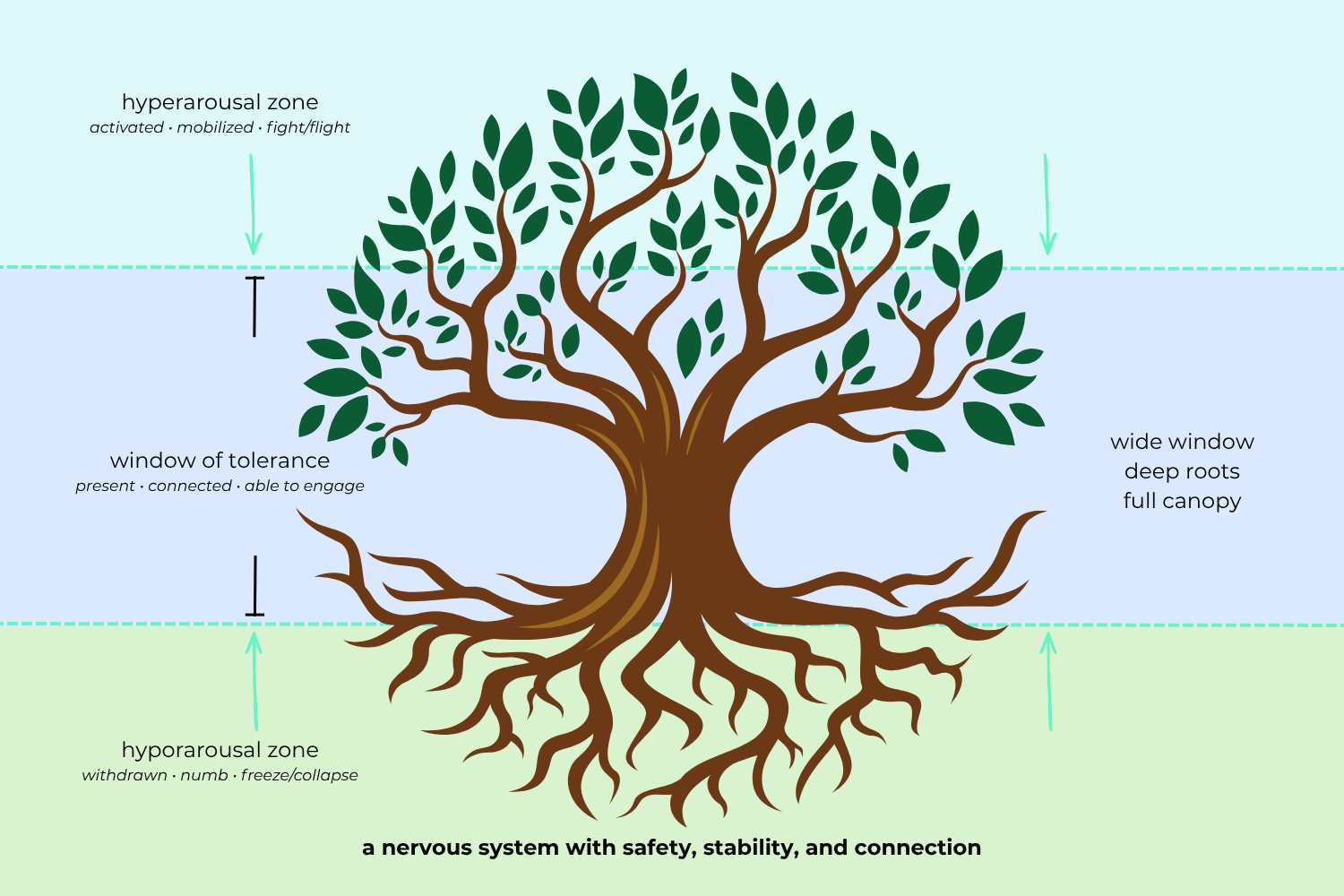
When life has been safe and predictable, the nervous system develops a broad, flexible range of responses. It can move fluidly between activation (energy, engagement, readiness) and rest (relaxation, connection, ease). It can tolerate discomfort without being overwhelmed. It can recover from stress without getting stuck. This is often referred to as the Window of Tolerance.
But when life has involved significant threat — trauma, chronic stress, oppression, instability, loss — the nervous system adapts. It makes adjustments based on the reality it's actually living in, not some idealized version of safety that wasn't available. In this case, your Window of Tolerance is quite narrow.
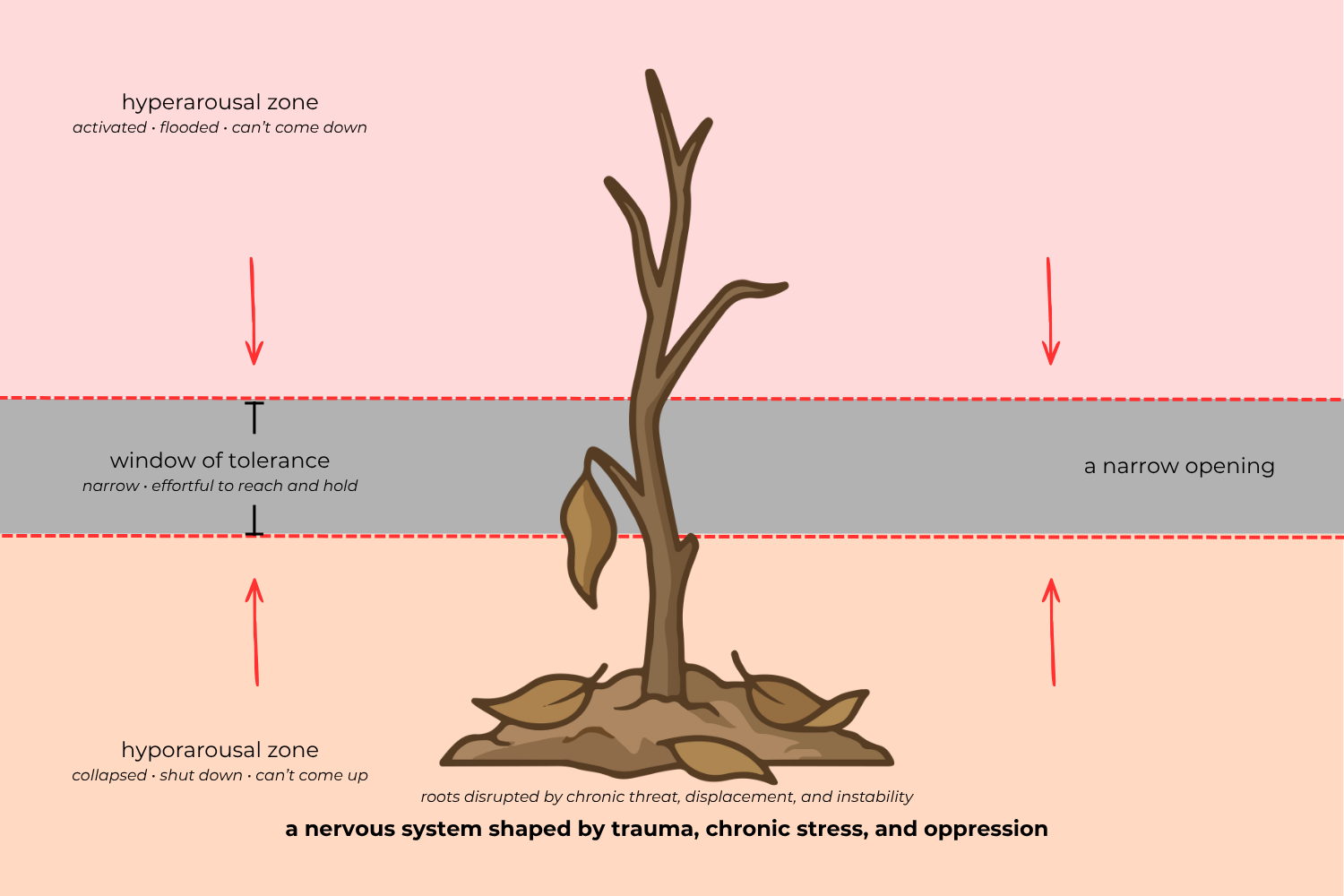
Those adaptations might look like: anxiety that seems to fire for "no reason." Emotional shutdown when things get hard. A hair-trigger stress response. Difficulty trusting good things or seeing them as “pointless.” Numbness where feeling used to be.
These aren't malfunctions. They are the predictable, logical outcomes of a system doing its job — a job that was shaped by real circumstances.
The Language We Use Matters
When we describe nervous system responses as broken, disordered, or wrong, something subtle but significant happens: we locate the problem inside the person. Inside ourselves.
We say: you are too anxious. You are too reactive. You are too shut down.
And the implicit message underneath that is: you should be different than you are.
But the nervous system doesn't adapt in a vacuum. It adapts in response to the world it's actually living in. For people who have experienced trauma, for people navigating systems that were not built to keep them safe — for trans and nonbinary folks, for queer people, for BIPOC, for disabled people — many of the nervous system responses we're quick to label as dysfunction are direct responses to real, external conditions.
That's not dysfunction. That's cause and effect.
None of which means that these adaptations don't cause suffering. They can and often do. The point isn't to dismiss the pain — it's to locate it correctly, so that healing can actually address what's real.
What "Adapted" Actually Means
Adaptation, in this context, doesn't mean optimal. It doesn't mean the responses that developed are the ones you'd choose if you had a full menu of options. It means they were the best available response given the circumstances.
Think about it this way: if you grew up in a home where emotional expression was punished or dangerous, emotional shutdown is a very sensible adaptation. If you've moved through the world in a body that others have treated as unsafe or wrong, hypervigilance makes complete sense. If you've experienced loss without adequate support, difficulty trusting good things is a reasonable hedge against future pain.
These adaptations kept you functional. Maybe they kept you alive. They deserve respect, even when they've outlasted the circumstances that made them necessary.
What healing actually looks like isn't eliminating these responses. It's expanding your nervous system's range — slowly and on your own terms — so that more options become available. So that the shutdown isn't the only tool. So that rest becomes something your body can actually access, rather than just a concept you've heard about.
This Is Why "Just Relax" Doesn't Work
If nervous system dysregulation were simply a matter of not knowing that relaxation is available, telling someone to relax would work. They'd relax.
The reason it doesn't work is that the nervous system isn't responding to logic. It's responding emotionally and somatically to patterns, history, sensation, and prediction. It doesn't care that the threat is technically gone. In some cases, it may not even know that it’s gone. It learned, from real experience, that threats can return — and it's doing its job by staying prepared.
This is why body-centered, somatic approaches to healing are so different from approaches that primarily work through insight and understanding. Understanding why your nervous system does what it does is genuinely useful. But it rarely, on its own, changes the pattern.
What shifts the pattern is new experience. Experiences of safety that the body can actually register, not just the mind. Experiences of settling, of being held, of presence, of genuine ease — accumulated slowly, over time, in a context that's actually trustworthy.
That's slow work. It's not always linear. And it starts, almost always, with stopping the war against your own body.
Starting With Respect
If you've spent years fighting your nervous system — trying to override the anxiety, push through the shutdown, force yourself to feel or not feel — you know how exhausting that is. And how little it actually helps.
What tends to work better, and what somatic approaches are built around, is starting from a place of genuine curiosity rather than correction. Not: “What's wrong with me and how do I fix it?” But: “What is my body trying to do here, and what does it actually need?”
That shift — from combat to curiosity — is often the first real movement toward healing. Not because curiosity magically resolves trauma, but because it changes your relationship to your own experience. And that relationship is the ground everything else is built on.
You Don't Have to Do This Alone
If reading this stirred something — a recognition, a grief, a kind of relief at being named accurately — we want you to know that there's support available.
At Soma Roots Therapy, we work with people who are tired of being at war with their own bodies. We approach nervous system healing from a somatic, body-centered framework — moving at a pace your system can actually tolerate, without pathologizing what your body learned to do to protect you.
If you're curious about what this kind of work might look like for you, we'd be glad to hear from you. You can learn more about our approach or reach out through the contact page whenever you're ready.
Your nervous system did what it had to do. Healing is learning what else is possible.